


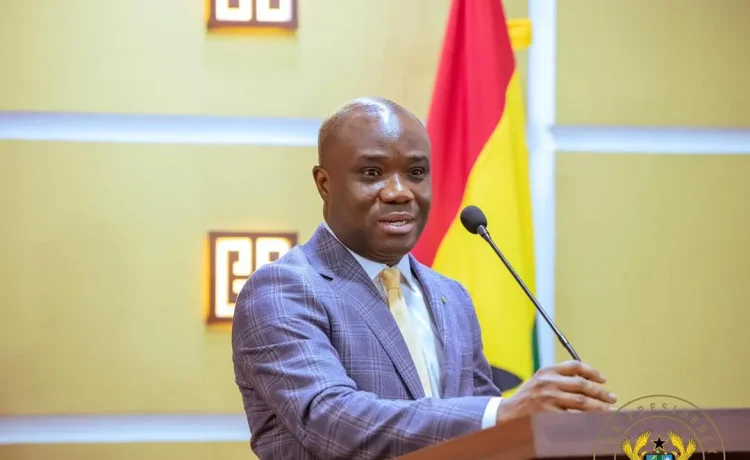
The Minister of State for Government Communications, Felix Kwakye Ofosu, has appealed to the Ministry of Finance and the Ghana Revenue Authority (GRA) to grant tax exemptions to state-owned media organisations to help ease operational pressures and enhance their competitiveness.
Speaking in Parliament last Thursday, Mr. Ofosu also called on lawmakers to support the proposed waivers, emphasizing the vital public service roles these institutions play and the urgent need for policy interventions to sustain them.
He identified key institutions such as the Graphic Communications Group Ltd (GCGL), Ghana Broadcasting Corporation (GBC), New Times Corporation, and the Ghana News Agency (GNA) as bearing the brunt of exorbitant import duties on essential equipment and materials.
“Since assuming office, I have been inundated with requests from all state media,” he said. “The Graphic Communications Group, for instance, has raised concerns about how expensive it is to import and clear newsprint at the ports.”
GCGL, which operates as a state-owned limited liability company, relies entirely on internally generated revenue to cover salaries and production inputs. These include newsprint, inks, machine parts, and chemicals—all imported in foreign currencies. The company reportedly spends around GH¢4.5 million annually on import duties and taxes, excluding those related to its subsidiary, GPak.
Mr. Ofosu noted that while GCGL is subject to strict procurement laws and financial regulations like other public institutions, these requirements hinder timely decision-making and responsiveness in a fast-paced media environment.
GBC’s Legacy Debt and Operational Strain
Turning attention to the GBC, the Minister revealed that the broadcaster is currently burdened with a legacy electricity debt of GH¢18.8 million, comprising GH¢13.77 million owed to the Electricity Company of Ghana and GH¢5.11 million to the Northern Electricity Distribution Company. The debt stemmed from shared utility arrangements with co-located state agencies—such as the Police Service—whose bills were formerly covered by government.
Despite GBC meeting its current electricity obligations, the historical debt remains unpaid. Mr. Ofosu also lamented the absence of capital investment from the central government over the past two and a half decades, with the broadcaster forced to depend on its limited revenue and sporadic foreign support—mostly from Japan—to maintain outdated analogue infrastructure.
He highlighted that GBC’s only functioning outside broadcasting (OB) van is nearly 20 years old, forcing the corporation to rent high-specification OB vans at costs of up to $15,000 per day during major national or international events. This, he argued, is neither economically viable nor sustainable.
Challenges in Expanding Regional Coverage
The Minister further noted that the creation of six new regions has added to GBC’s constitutional mandate to maintain a presence in all regional capitals—a target it has so far been unable to meet due to infrastructure and funding deficits.
He revealed that a past agreement between GBC and the Ministry of Finance would have seen the corporation receive financial compensation in exchange for land adjacent to the Jubilee House, intended to fund FM stations in the new regions. However, he said the Ministry has yet to honor its commitment.
“We will continue to pursue the matter with the view to having the payment effected,” he stated, stressing the urgent need to modernize and reposition GBC and other state-owned media to operate with greater autonomy and relevance.
Mr. Ofosu concluded by pledging to keep Parliament informed on developments and expressed hope that both the Executive and Legislature would rally behind measures to strengthen public media institutions in Ghana.